

In my October post, I gave the impression that the case for the wind turbine was all cut and dried. It wasn't, as it turned out, and was a lesson to me on accepting real data as real. I had very much wanted a turbine for two reasons: 1. when the wind blows strongly, it's generally the time you need energy; 2. our location in NW Wales should have been pretty good for windiness. This latter assumption was strongly backed up by the two national databases of wind speed averages and predicted power output. The latter, as it turns out, was wildly optimistic.
NIMBY neighbours do us a favour: We had a tense meeting with our downwind neighbours, arranged to test the waters before formally applying for planning permission. They were implacably opposed to anything visible or audible and I found myself having a little sympathy with their views such that we agreed to go back to the drawing board and see if there were alternative sites or just alternatives. So, Val and I had another look at the results for the average wind speed yielded by the anemometry; the real data. I had previously suspected the anemometer of under-recording wind speeds and, with this in mind, we had checked its calibration by holding it out of the car window at different speeds on a calm day. It was spot on.
And the real average wind speed? I had two results from the anemometer read-outs. One was the average wind speed and the other was the average gust speed. I had - wrongly as it turned out - assumed that the true average would be the average of these two averages (the 5.1m/s figure I quoted in the earlier post). I was always worried about this assumption and had made efforts to find out the correct position, so I posted a question of Green Building Forum and Val phoned an anemometer company and discussed the issue with an expert. The upshot of Val's chat was that we should totally ignore gusts! So that means that the windspeed on my best exposed site in windy north Wales is a paltry 3.58m/s, averaged over almost 12 months! So a wind turbine is out for the best reason of all: there really isn't enough wind on this site. The anemometry and neighbours' complaints saved us from jumping to the conclusion, fostered by the databases I mentioned above, that windpower was for us. So we are saved from acrimonious disputes and almost inevitable planning rejection, from appeals and from building a 25k pound white elephant!
So we're now looking at photovoltaics for which no planning consent is needed. Feed in tariffs of around 36 pence/kWh make this a viable option.
The moral of this story: If you're thinking of putting up a turbine, do the anemometry and believe the results!
Saturday, December 05, 2009

Tuesday, October 20, 2009
Planning for wind

I have just written to our local planning officer to find out how the land lies for a full planning application for our intended Proven 6kW turbine.
Why a wind turbine? As you may have read in earlier posts, we propose to install a small wind turbine on our farm in Llangybi, north west Wales. We have two reasons for wanting to undertake this project: firstly we feel we have to do what we can to help combat climate change and are already doing what we can. We have grandchildren and are concerned about the world they will inherit. In this windy area, a turbine is easily the most practical way for us to more than neutralise our carbon footprints. As we approach the critical United Nations Climate Change Conference in Copenhagen, our own government exhorts us all to take action (Act On CO2). This we want to do. Secondly, the turbine should generate a useful income (particularly with Feed In Tariffs) and thus become an additional diversification for our main farm business of growing vegetables in a co-operative for our local box scheme. Details of this environmentally friendly scheme are available on the Llangybi Organics website.
The Site: This is to be in the centre of our land, as far from neighbours as possible whilst consistent with being appropriate for turbine location. You can also view the site on a Google map (a pin marks the spot and the high-resolution satellite imagery shows the hedgerows clearly ).
Windspeed data: A viable average windspeed for microgeneration is generally taken as 5m/sec. How do we best know what our average windspeed actually is?
- NOABL (BIS) database gives 5.3 - 5.6m/sec for 10m above ground level (agl) (grid squares SH4341 and 4241 in which the turbine will actually be located) and 6.1 - 6.3m/sec at 25m agl. Turbine hub height of 15m agl should receive an average of 5.7 - 5.8m/sec.
- Carbon Trust Wind Yield Estimation Tool gives 6.0m/sec at 15m hub height with anticipated 13,885 kWh/y generation potential with corresponding CO2 saving of 7.456 tonnes/y
- Anemometry from October 2008-October 2009 on exactly the planned site with anemometer 11m agl has given average wind (in a year with long periods of blocking anticyclones) at 5.1m/sec based on 147,331 data points. For a description of this, see my previous post. [By the way, this complete set of equipment is now for sale so if you're interested, let me know by way of a comment with your email address. This includes the data logger base station, anemometer and everything needed to connect to a PC including software and cables, the 11.5m mast and supporting gear. I have even calibrated the anemometer. About 100 pounds for the lot!]
Distance from neighbours
Cae Du (upwind for the prevailing southwesterlies) c.160m
Llwyn Helyg (downwind) c.200m
Brongybi (to west) completely shielded by intervening woodland
Turbine details: Proven 6kW on 15m mast (high enough to avoid turbulence from hedgerows and a serious reduction in performance). The installation will be about 60m from our house where it will be connected to the grid via an inverter. Its slow rotation speed and direct drive (no gearbox) means that this turbine is both reliable and the quietest on the market in its class (e.g. 45dBA at 5m/sec). The result is that noise from the turbine is reduced to the swish of the blades turning in the wind, virtually unnoticeable compared with
background sound. See and hear examples from our intended installer's website. And yes, we have been and stood underneath these turbines and they really don't make much noise. The more the wind blows, the more noise there is from the wind in the trees and hedges which tends to drown out the increased whooshing of the turbine.
We await the planner's views before we pay something like 300 pounds just to ask for permission. In this day and age, you'd think every small farm like ours would be encouraged by government to put up turbines. It may come as permitted development rules change and the urgency for tackling climate change finally sinks in.
Sunday, March 29, 2009
Earth Hour in Llangybi
 Yes, we celebrated Earth Hour on Saturday night. I previously had thought it pointless but the WWF-inspired campaign has gone from strength to strength this year.
So even if it didn't help cause a dip in energy demand (signalling a 'vote' for low-carbon alternatives), it was somehow good to be sitting in front of our logburner with only its flames for light plus that of a beeswax candle. We thought of all the other thousands of people around the world who were doing the same thing at 8.30pm, from time zone to timezone as the planet rotated. There was a sense of solidarity and connectedness and, yes, voting for an end to the Age of Stupid fossil foolishness!
By the way, we used a beeswax candle because paraffin wax candles are made from oil products and we have to be purist about this, don't we! The carbon-neutral logs are from the farm with not even 1 wheelbarrow mile on them. Kosher, eh? Smug, no.
Wednesday, October 22, 2008
Shooting the breeze
 We've started on the road to finding out whether a wind turbine is feasible on the farm. The turbine we have in mind, a Proven 6kW, costs in excess of £20,000 fully installed so we want to be sure that this is money well spent. So we've started logging wind speed and we'll continue to do this for 6 months at least. To be properly viable, we need average speeds of over 5 metres per second (m/sec or about 11 mph) at the height of the turbine hub; that's about 15 metres above the ground. As I write, the wind is blowing at double this speed. But how did we get a setup working to do this? That's the point of this post because I could find very little help on the practicalities of how to do this. I hope others will find our experiences helpful.
Logging wind speed: The basic idea is to get an anemometer up in the air as high up as the turbine would be and then log its readings for as long as possible. Fifteen metres is quite a height so we settled for 11.5m which we achieved by buying 8 lengths of swaged (one end made smaller so that it fits inside the next pole piece) aluminum pole with the other bits and pieces needed to support it in strong winds. I found an excellent company called Moonraker which sells masts, spiders (clamps which fit on the mast at intervals and enable you to attach guys) and guys. I've already given details of the anemometer we're using. There's a slide show here so that you can see the stages of erecting the mast.
How to put up a mast: First, do a scale drawing. The scale I used was 1cm to 1 metre (1:100). You need a map view (as if seen from above) and a vertical section. These drawings allow you to work out exactly how long the guys will be. The angles between the guys and the ground should be 45 degrees. For an 11-metre mast, experience tells us that you need four spider clamps for attaching guys at 120 degrees (map view) to each other to give maximum possible stability. (We tried putting up the mast using just two spiders and quickly realised that they were not sufficient and so took the mast down again.)
Then you need to lay out the locations on the ground of the guy anchors and mast base. This is easily done with a 30m tape and compass. Extreme accuracy isn't needed. Mark the positions with sticks. Next, number the mast sections and work out from your drawing where to attach the spiders so that they are equidistant all the way to almost the top (thus leaving space for the actual anemometer). For guy anchors, I used pieces of reinforcing bar and other pieces of scrap steel I had lying around. Hammer these into the ground at 45 degrees away from the pole and attach the guys to them. I made fencing wire to make eyes for the nylon 3mm guys, top and bottom, so they don't chafe. It's all rather like putting up a tent.
Up it goes: Erecting the mast requires you to have some kind of platform at least half the height so that someone - in our case, Mark, our neighbour - can stand safely and guide the pole as you add pieces from the bottom. I have a scaffold tower and this was perfect for the job. You can hire these. When all is ready, you start by fixing the anemometer to the top piece and then attaching the first 3 guys to the spider directly below (see photo above and also the slide show). I held the mast and lifted it up as Val added the next pieces. The whole mast is no more than about 10 kilograms so this is easy enough. Each time a piece with a spider went on, Val would fetch the respective guy, pre-laid out and cut to the right length, and attach it to the spider with a secure knot. And so on... Mark was up on the platform guiding it and monitoring the spider angles so that the anemometer itself was aligned East-West and the spiders were all in line. Val would also tape the anemometer feed cable to the mast every metre so that it didn't flap about. Sounds complicated but it wasn't. The whole thing went up in about 10 minutes. The secret is in good preparation and treble checking that everything is where it should be and amply long enough in the case of the guys. So far, the mast has stood up to a gale without problems. Plenty more gales can be expected, for we're approaching winter and the jet stream steers plenty of heavy weather across Wales.
Sit back and watch the data! Not just yet. The final stages are to adjust all the guys so that they mast is vertical as seen from anywhere. It helps to have a long spirit level to do this. Guy adjustment is easy using standard tent guy adjusters, available from camping shops. We were tweaking the adjustments for the next day or so as the winds picked up, but don't overtighten. The anemometer feed cable plugs into a battery-powered radio transmitter which we taped near the base of the mast. This transmits the wind speed and direction data to the receiving base station. I find that the reception is fine on the kitchen windowledge, within line-of-sight and about 70 metres away from the mast. Once this is all set up, the data starts rolling in. The base station can collect data every 5 minutes for about 6 days and has a port which allows you to connect it to your computer and download all the stored data. There's a program which comes with the weather station which processes this data and presents it to you either as a list or a graph. And that's it. I've had it running for 5 days so far and it's fascinating to see the results (image below: green lines are gust speeds and red the general wind speed. Click this image for a larger version).  Next, I have to find a program which will read tens of thousands of datapoints (1 every 5 minutes for months) and give me the figure we need for average wind speed. I can import the data into Excel but I don't know how to get the program to calculate an average. I'm sure I can find out!
 Next, I have to find a program which will read tens of thousands of datapoints (1 every 5 minutes for months) and give me the figure we need for average wind speed. I can import the data into Excel but I don't know how to get the program to calculate an average. I'm sure I can find out!
Monday, September 15, 2008
Wind turbine: the start
Beginnings: We've started the lengthy business of investigating the possibility of installing a wind turbine. I'd already homed in on Proven as being the best of the bunch of small wind turbines. The 6kW machine looks like the one we'd opt for, the aim being to provide much of our power and to export the surplus to the grid. The video is of one of the four 6kW Proven turbines which form the backbone of the island of Eigg's grid during a visit in June. Most of the noise is the rumble of the strong wind in the camera's microphone.
Site visit:
 There are a number of hurdles to leap before any final decision can be made. I requested a visit from Tony Carver of Natural Energy, an approved installer of Proven turbines, who kindly agreed to make a site visit without charge. I showed him the site I thought most likely, within reasonable distance of the house for connection purposes but quite open to the prevailing southwesterly winds, the prevailing wind direction here. He accepted that this was indeed the best option and then erected a 10-metre telescopic 'flag pole' (pictures) with a balloon attached for visibility, just to give an impression of the height of the tower. This wasn't too successful as the day was, ironically, very windy and the thin pole bent like a long fishing rod! Tony and I had both checked the BERR windspeed database for the area. It provides averaged speeds for each
 kilometre square of the country and so gives a rough idea of what to expect. It suggests a speed of 5 metres per second would be the average at 10 metres above ground level. This is just about enough to make the economics worthwhile. But to be more certain, there's another hurdle to jump before considering the trickiest hurdle of all: planning consent. (I anticipate problems here but hope I might be proven wrong.)
Anemometers away! You can purchase an anemometer kit for just over £100. Tony Carver
 suggested I should do this and stick the device on a scaffold pole tower for a few months. I have followed up his suggestion and purchased a LaCrosse WS3502 wind station (pictured, in fancy box). This comes with a wireless transmitter and base station. It claims a range of 100 metres so I should be able to pick up the transmissions from the house. It also comes with software to enable all the readings of windspeed and direction to be uploaded to my computer and for averages to be calculated; in short, all I need to find out accurately what the wind speed average at the proposed turbine site actually is. The next stage is to find some way of getting it on a sturdy pole at least 10m high and to that end, I have applied to join the Green Building Forum so I can solicit ideas about how best to do this.
And the economics? Will the outlay be justified? We're looking at a capital cost in excess of £20,ooo. To put it in other terms, that's a lot less than a luxury SUV which is guaranteed to guzzle energy and money. In contrast, this machine -- with a design life of 25 years -- will generate money every time the wind blows above its cut-in speed of around 2.5m/sec. Unlike some turbines, this one doesn't shut down in severe gales. It just carries on generating at its maximum output of 6kW.
When I started thinking about turbines, I did so from the point of view of being green. I no longer see it like that. I'm now interested primarily because the machine can reliably generate money. Which is better? I wondered. Have the money in the bank with inflation going up, stock markets going down and recession looming? Or have the capital asset of a sturdy turbine which could be generating me a thousand or two each year? Add on the rapidly increasing costs of electricity supply, the increasing ROCs (explained here) and the near certainty that even the laggardly 'green' British government will soon have to instigate a feed-in tariff scheme, the cash generation potential of my turbine can only increase. That's what I'd call a good and secure investment... green too!
But it could all come tumbling down at the next two hurdles: wind speed average and planning consent. You'll be hearing from me again...
Thursday, September 27, 2007
Warm at last!

Mission accomplished: The Mur Crusto passive solar gain project is largely complete and we’re reaping the benefits immediately. We should have done it years ago. There’s more to do, of course, but now if you want, you can see all the best pictures of the construction from beginning to end. Click here to take you to my photo album where you can choose either to see all the captioned pictures as a slideshow in sequence, or move around the album of thumbnails to click any you're interested to see full-size.
Wonderful to be warm! The most obvious immediate benefit is that the core of the house, previously like a cold store even in summer, is now permanently warm. The temperature outside last night dropped to 3 degrees Celsius but we were perfectly warm in our living room, needing no additional heating. Remarkably, even late in the evening, the conservatory still felt quite warm. So we really are reaping our passive solar gains.
Battle against the weather: This summer has been lousy. A lot of it was dry but cold, but there have been long periods of 'unsettled' weather; Met Office parlance for rain and wind. Whilst there was no glazing, the concreted floor (see photos) repeatedly flooded and had to be pumped out. I developed a sort of 'cut and run' strategy for working, keeping all my tools in a wheelbarrow and coming out when the rain stopped. I'd work until the next rain and then trundle everything away into shelter. This is no way to work but I had no choice. Latterly, we did have a few weeks of dry weather which was perfectly timed for me to get on with glazing the roof and then the windows. Glazing the roof was what one might term 'a non-trivial operation'. (It said in the assembly instructions something like, "Now glaze the roof"!) Doing the lead flashings before that was also quite difficult, lead being heavy and difficult to fit in the continuous slot I'd cut in the wall of the house. But the roof glazing took the biscuit for difficulty: the glass units are heavy and locating them tricky. The seals for waterproofing are fiddly and messy (silicone all over the place). But I managed in about 2 weeks of struggling.
Last minute: The last pieces of glazing went in the east gable end a matter of 2 hours before the rain started again, just in time to stop the loss of warm air from inside the structure. From that time on, it's been a different world inside. Lots of light, warm space and the wonderful feeling of warmth flowing into the old, formerly cold, stone building -- all for free and without burning any fuel. There are a few small leaks which I have to sort out when the rain stops but otherwise, it's really great. Everyone should do this if they can. It really makes a difference!
The next stage: To gain the full advantage of this structure, I have to complete various things. One is the floor which I shall insulate. Another is the internal wall plastering and painting with a tinted paint ('sandstone' is the name of the tint). White houses are a serious mistake; very pretty but cold. It's just like the (vanishing) Arctic sea ice. Being white, both reflect almost all heat away. A dark wall or ice-free sea surface absorb most of the solar radiation and so heat up: good for warm housing; bad for warming oceans and accelerating ice melt. It's the albedo effect and it applies to houses just as it does to the Arctic Ocean. Ideally, I'd paint the internal wall black to absorb as much heat as possible and act as a massive heat store. But one has to compromise. A black house is not acceptable! So it's going to be that sandstone tint. Even so mild a colour makes a difference too. On a sunny day, place your hand on the white paint and it's cold. Place it on the sandstone paint and it's nice and warm.
Controlling the warmth: I also need to investigate simple control systems to duct heat actively into the house, using a fan, but only whilst there is heat to duct. In other words, I need to devise a simple system which switches on whilst it's hot in the conservatory and off when it's not. It would ideally recirculate the cooler air from the house into the conservatory for re-heating. What I don't want to do is dump heat into the atmosphere if it's needed in the house. If you, reader, have any ideas about how best to do this, please leave a comment below this post. I'm sure there are systems available so I don't have to re-invent the wheel.
Details of the building: For those interested, the U-value of the low-e double glazed units is 1.3 (Planitherm). The conservatory was manufactured by Portland Direct, the DIY branch of Amdega, all made from treated and painted softwood from (they claim) sustainably managed Scandinavian forests. This large structure cost around £10,000 delivered, with telephone back-up support available and very good. It's guaranteed for 15 years. The other bits and pieces (like blocks, cement, lead and so on) have probably cost another £1500 or so.
Then there's the small matter of my labour. I started excavations in January and completed the glazing in mid-September. I have probably spent one third of my available time working on this during that period, saving 4 weeks away in Scotland. Val has helped when needed, particularly with laying concrete and holding things in position and I have employed Simon, a carpenter friend and one of our organic veg customers, for 4 days in total. That's about it. Hard work, definitely a 'non-trivial operation' but rewarding. Most reasonably fit (I'm aged 60) and reasonably competent people could do similar. Building is, in part, a question of thinking things through slowly and carefully before doing them and using ingenuity where possible to save time and trouble. So... go for it!
Tuesday, April 24, 2007
Going down; going up!
 Passive solar project continues...
Going down: At last, the digging out and barrowing on tons of boulders, stones and earth are over. The deepest part of all was the foundation for the 'dwarf' wall which will support the conservatory structure. Here (right), Val is checking the base level of the foundation trench with the water level (see previous post). Fortunately, because the ground is so hard and stony - thanks to glaciers 14,000 years ago - foundations can be minimal.
 Going up: From this point on, it's up! First the foundations, then the base part of the dwarf wall which I've arranged so that the top of the blocks is exactly the same height as the finished floor level inside the structure. At least I hope I have. Val and I have treble checked levels, measurements and angles, all of which are made more complex by the front wall of the old farmhouse (to which the conservatory will attach) along which nothing is true; neither vertical nor plane.
 Attention to insulation: The picture (above left) shows me, on a hot day wearing my sombrero, setting out the first double line of blocks. I'm using a sheet of Ecotherm insulation to ensure that the wall cavity is wide enough to hold these sheets when I build the rest of it. I intend to have 50mm of this high-quality insulation within the wall cavity and another 50mm attached to the inside and covered finally with plasterboard. I've found from my experience of building our holiday eco-cottage that insulation pays massive dividends. I shall also be insulating the floor. On the right (above), I'm pouring what seemed to be the thousandth barrowload of concrete - it's hard work! - to form the floor slab, 100mm thick. Underneath it is the black polythene damp proof membrane which we've lapped up the wall of the old house (which has neither foundations nor damp proof course) and over the first block of the dwarf wall. The damp course must always be above final outside ground level, of course.
Sub-floor complete! I finished pouring the final load of concrete just the day before it started to rain, the first rain for about 5 weeks. I'd worked 5 days previously, about 3-4 hours each day, making concrete, barrowing it and pouring it into 'cells' formed by pieces of timber. The top of each timber Val and I had carefully levelled (water level again) to ensure that the top of the levelled and tamped concrete would be about 100mm below the finished floor level. This leaves room for the underfloor insulation. As I write now, the concrete slab is flooded with water from all the lovely rain.
The next step: The conservatory frame arrives on a lorry in 3 days, complete with all the double glazed low-e glass ready to be installed when the frame is up. When the rain stops, I'll get on with building the rest of the dwarf wall at which point the excitement starts: will the frame fit? are my measurements correct? how long will it take? Already, the pressure's on... we've got our table and chairs on the new concrete floor (photo 3 behind) and look forward to having the finished structure which, we hope, will solve many of our old house's heating and insulation problems. We are, in short, fed up of living in a permanently frigid house. (It's frigid because there's no proper insulation and we refuse to run oil-fired heating except for an hour or so in the early morning.) The conservatory will help immensely because I intend to arrange for surplus heat to be ducted into the old house, effectively using the walls as a heat store. How effective this will be we can't be sure but it certainly will be better than the way things are now!
Wednesday, January 24, 2007
The Grand Conservatory Project: space heating from the sun
 |
Construction - mostly destruction at this stage - is underway. I've been nipping out for a few hours most days when the gales and heavy rain stop to remove a rockery and completely rebuild a clawdd wall. This is to make space for The Conservatory which, we hope, will result in a much warmer house, partly because of its insulating properties on the solid stone wall of the exposed front of the house and partly because I intend to duct heat captured inside the conservatory into the usually-cold inside of this traditional farmhouse. I hope the walls will act as a heat store. That's the idea anyway. Any ideas for simple control devices and fans welcome! (Please add a Comment.)
Now that the rockery and wall are 'rearranged', there's a lot of heavy work ahead shifting barrowloads of soil and rocks. I've tried to arrange things so that I don't have to move stuff twice. So the biggest boulders - some of which I could only just manage to slide or roll - will form the basis of a new rockery in the middle of the garden, burying the existing ugly concrete path which with dozens of barrowloads of soil. So most of the excavated materials aren't 'waste'; they're useful in a new and more attractive context: a rockery in the middle of a single lawn no longer bisected by the ugly path to the gate which was never used anyway.
 |
Now that I have the detailed drawings of this conservatory from its manufacturer, Val and I set up a datum level which is based on the distance between the base of the upstairs windowsill and the top of the conservatory 'wall plate': the highest timber of the frame which is bolted to the building. I have to leave space below the sill for flashing to go in or it will leak. That done, we checked with a water level that both sills were the same height (they weren't) and measured down to a point which is 1 metre above the finished floor level, marking this with a line. I then attached one end of water level to the wall. This means I can attach the other end of the level to a measuring post whose length below the level is at precisely the depth below the finished floor level that I need to excavate. That is 1.2 metres for the path which I will make along the front of the new structure, allowing for a dampproof course to be made at floor level in the dwarf wall which I will build to support the conservatory frame and glass. The glazing, by the way, will be low-e glass, double glazed, with a U value of about 1.3. Pretty good.
Excavating is the way it's going to be for a few more days if the long-awaited colder, drier weather persists. Then the fun starts! I have to break up the existing concrete 'patio' where the conservatory structure is to be built. This is a hodge-podge of patches of different concrete and different levels and so, unfortunately, has to go. Will I do the breaking by hand (sledge hammer) or hire a hydraulic breaker? I think the latter! But do watch this space...
Thursday, December 21, 2006
Good news and bad news

First the good news: we got planning permission for the large conservatory that we wanted to build onto the front of the house. The intention was and is for passive solar heat capture. So now I'm starting the major excavations needed to prepare for the foundations and insulated floor. We're aiming for low U values throughout the structure so the floor and support wall will be well insulated. I try to do a couple of hours of levering and excavating of huge stones each day.
Now the bad news: Despite trying hard to get everything right so far as building regulations are concerned when constructing the eco-cottage, we've failed on several things in the final check. We are both quite angry and upset about this because we feel strongly that we just didn't get the support we needed, as self-builders, during construction. Let's hope matters are resolved satisfactorily when we meet up with the Building Control Manager in early January. Elsewhere in Europe, self build is common but in the UK, very few people have the courage and commitment to do it themselves. Part of the reason, I'm sure, is because 'the authorities' don't much like them and the system simply doesn't allow for non-professionals to receive kindly guidance so that they get the regulations bit right first time. In our case, you'd think that our cottage would be a shining beacon of effective renovation and proper construction for the low carbon build which we should all be aiming for. But nobody seems interested in our massive insulation and SAP rating of 107 (the maximum possible is 120). Shame!
Saturday, November 11, 2006
Getting real... about pumps

It's taken some time for the light to dawn: pumping water with 12 volt batteries is an expensive waste-of-time. I've been through several pumps and lugged several generations of heavy lead-acid batteries across the field and finally accepted the blindingly obvious: a mains powered pump is a much easier and more reliable solution to keeping the rainwater tanks (for polytunnel drip irrigation) full. Originally I'd intended to power the whole system by wind or photovoltaics but the expense and complications of doing this meant that I never did it.
So I bit the bullet last week and unrolled a long coil of cable - the run is about 80 metres - and now have an almost-silent submersible pump which pumps the rainwater collection ponds in about one tenth the time of the 12 volt pump (which was twice the price), its predecessor. It also automatically switches itself off with a floating switch. Now I can relax in front of my widescreen telly...
Moral: Avoiding using grid electricity for 'green' reasons can often be a much bigger waste of resources, not to mention a very big waste of money.
Thursday, September 21, 2006
Eco-farm project: conservatory and planning permission
I was wrong about the local planning department. Val, armed with drawings and a version of my previous post, went in to see the planners - prepared to do battle. She was disarmed almost immediately because the planning officer announced that he could see no reason why such an application would not be successful. Total surprise for us both, having encountered problems before.
Val has now got design plans from a conservatory manufacturere (Baltic wood from 'managed' forests, whatever that means) and in the next couple of days, we'll complete the application forms and submit them. Then there's a wait of 4-6 weeks before we get the answer.
We may, however, design and build the structure ourselves as we did for the holiday cottage conservatory. It all depends on the specs we want being satisfied and the overall strength of the structure: it has to be able to withstand the fierce gales we get here at this time of year.
Sunday, September 17, 2006
Mur Crusto eco-farm project, Llangybi
These are the basic plans we intend to put before the local council. I expect objections from them and will post further as things proceed. The idea is that if we can retrofit this cold, damp farmhouse to make it energy-efficient, something similar can be done with almost all the other poorly-insulated housing stock throughout Britain (or anywhere else where winters are cool, energy used to be cheap and insulation was ignored).
Aim
- To be energy autonomous: an example of low-energy living with carbon emissions cut to a small fraction of ‘normal,’ based on retrofits to existing buildings (difficult but no alternative) rather than new build (easy).
- To be sustainable: growing quality food without high energy inputs and without pollution
Development so far
- Successful organic veg- and fruit-growing box scheme provides wholesome fresh food to local people (around 35 families), with zero ‘food miles’
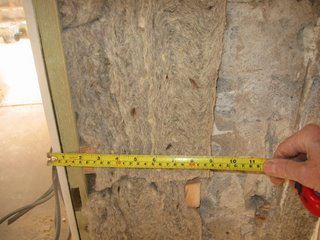
- Barn conversion to holiday eco-cottage completed in 2006 by ourselves and now successfully attracting regular visitors. Exceptional attention to insulation (see image, sheeps’ wool) and use of renewable electric power (from Ecotricity) means that this building has a SAP rating of 107 (max. possible is 120) and zero carbon footprint. Heating is electric underfloor and is only needed in the coldest weather. Top-up heating is by efficient log-burner supplied with wood from farm: carbon neutral. Double-glazed conservatory provides major solar gains for whole building.
- Minimsed carbon emissions from Mur Crusto house by universal use of low energy bulbs, pipe lagging, insulation where possible and minimal use of central heating after installing new efficient boiler

Planned development
Problem
It is effectively impossible to insulate existing farmhouse because of its thick stone wall construction. It cannot be insulated on the inside because the rooms are already small and dark. Internal dry-lining would worsen this and require total interior demolition. , To be effective, external insulation cladding would require raising the entire roof and re-slating. Insulation in roof spaces already 300mm rock wool but much of the roof is inaccessible because of dormer window construction. Result: building is still a major source of carbon emissions from central heating oil with SAP probably below 30. It is also permanently cold. At present, we produce a minimum of 2.5 tonnes of CO2 per year with the oil-fired heating, run as little as possible. Main heat source is wood-burner (carbon-neutral) and well-insulated bodies. i.e. we wrap up well and try not to shiver when other people would just switch on the heating!
Solutions - in order of priority and dependant on our resources
1. Installation of double-glazed (e-glass) solar passive/semi-active heat collector/conservatory along south-facing front of house to cut down heat loss through walls and induct solar gains with controlled fans into house interior (using thermal mass of thick walls to store heat)
2. Installation of one or more Windsave 1kW turbines, grid-connected. Electricity savings such that one turbine should pay for itself in 5 years
3. micro CHP (combined heat and power, image right) installation instead of existing oil boiler. Savings of 1.5 tonnes/y of CO2 emissions normal for such installation
4. photovoltaic array, grid-connected, on south-facing and sloping roof of modern barn (consultants: Dulas Ltd, Machynlleth)

Final result
An energy-neutral sustainable farm, probably the first of its kind in Wales. Watch this space...
Thursday, July 20, 2006
Feeling the heat in 'rainy' Wales
 Yesterday, the temperature here exceeded those in the Mediterranean where you expect mid-30s Celsius at this time of year. In the polytunnel, the thermometer almost went off-scale as it reached 44 degrees C, a record. Unlike the Mediterranean countries, we still have plenty of water and so can irrigate. In fact, I went out during the stifling hot day at least 5 times to turn on the sprinklers (which I rarely use, preferring the far more economical drip system installed under the soil) for a few minutes at a time, just to keep the temperatures bearable for the plants.
This picture shows one of the rain water collection ponds outside the polytunnel. At present, they're pumped dry since there's been no rain.
Outside, I have to water the veg plots every night, each sector in succession. There hasn't been any serious rain for many weeks and the Met Office is not projecting any in the coming weeks, so far as I can see.
So we're having the hottest and driest summer since (my) records began... 6 years ago. That may mean nothing in climate change terms but it does make you think. And it reminds me once again how much easier it is to grow veg here than it was in Mallorca, where I used to attempt to farm on a small scale for several years. There, we had to rely for all our water on an old well which in times past supplied plenty of water, but all our rich neighbours had put down tubewells to far greater depths than our well's modest 8 metres and depleted the local water table to keep their vast lawns green and swimming pools full. Here in Wales, we have metered mains water which is unlikely to run dry... and, after Mallorca, I always appreciate the rain when it does come!
Thursday, March 09, 2006
War on the atmosphere: military aircraft emissions
 Insult to injury: George Monbiot's latest piece on aircraft emissions prompts this post; something I've been considering for some time. It is, in turn, prompted by the daily screech and roar of military aircraft over this 'peaceful' country haven in north Wales. Quite apart from any other considerations, this daily air and noise pollution is a continual affront to our attempts to live here as sustainably as possible. With one economical car (65mpg average and 116 grams/kilometre CO2 output), a wood-burner, low-energy lights, insulation and central heating used sparingly, our lifestyle is as low carbon as you can reasonably get in the carbon-fuel-dependent UK. Probably these aircraft burn up what we use in a year in just a couple of hours... but I don't know. Who does?... Or is it secret?
Aircraft emissions and the atmosphere: Okay, here's the issue: we know aircraft emissions are really bad for the environment, especially those at high altitude. Just how much fuel do the airforces of the world squander on training flights (or war games for big boys and their very expensive toys as I'm uncharitably inclined to regard them after the tenth jet in twenty minutes)? What proportion of total aircraft emissions do they represent? I have no idea but I'll bet it's more than you might think. No doubt it's a closely-guarded military secret. And what's it all for? That gross euphemism 'defence' (Orwell warned of this) is bandied about by politicians everywhere. But what's the point of it all (and upgrading nuclear 'deterrents' come to that)? In what way are these scary warplanes and their undoubtedly skilled pilots increasing our security in Britain? Consider little Costa Rica appropriately about the size of Wales: This little country doesn't have an airforce or any military force. The country is still there... and it has land borders with its neighbours making invasion easy, unlike seabound Britain.
Is war more important than climate? The biggest problem facing the planet now is climate change. Most of us, including politicians, would agree with that. So who is about to attack the UK which requires a large active fuel-burning airforce to repel? Terrorists? But everyone knows that terrorists' weapons are suicide bombers and cars packed with explosives. They don't use aircraft - except as flying bombs, one infamous day, in 2001. So why must we put up with this squandering of limited resources on things like military aircraft and the resultant pollution which endangers everyone, not to mention useless nuclear weaponry? Or is there another agenda we ordinary folk don't hear about, like invading Iran - as if the disaster of the US/UK invasion of Iraq wasn't lesson enough? Or maye it's just successive UK governments' desire to have access to the 'top tables' with their American friends, perpetuating the absurd post-colonial notion of 'punching above our weight' and the so-called 'special relationship' which must be nurtured at all costs? That's a lot of questions but how can I get some answers? I have asked my MP to enquire and he is doing so.
Lives are at stake here.
Monday, February 20, 2006
Every little helps: alternative energy sources
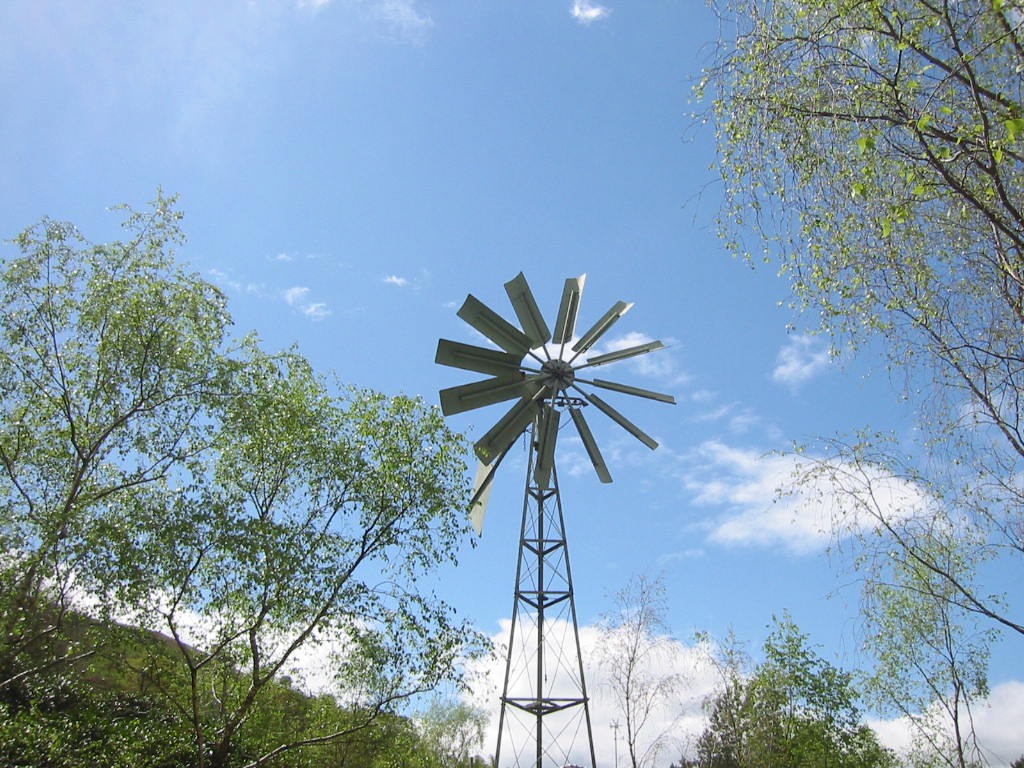
The problem with alternative energy sources is that they're either periodic (like tides or solar) or unreliable (like wind). The one exception is hydropower.
But isn't this the biggest obstacle to the wholesale adoption of renewables in the near future?
Well that was how I thought until my brother-in-law pointed out that every unit of renewable enery produced is a unit of fossil-fuelled energy saved. Blindingly obvious, of course, but I hadn't quite got into thinking that way. I had been commenting that all renewable generators required a battery or back-up system which was expensive and likely to depend on fossil fuels - or nuclear power. None of this alters the basic premise that a unit of energy produced (by, e.g., the turbine on your roof) is a unit which doesn't need fossil fuel to make. I repeat myself, I know, but then this is so fundamental, it needs to be repeated. And the argument about back-up sources really isn't very critical since the fossil-fuelled kit (power stations) already exists. Better weather forecasts mean that extra capacity needs can be anticipated well in advance so that boilers and turbines - not something you can swtich on and off at will - can be started. The aim, after all, is not to cease burning all fossil fuels, but to reduce their use by 60-80% to help stabilise the climate.
What's more, the larger the transmission grid (I know there are losses here), the more it can be used as a 'battery'. Gales in Scotland mean surplus generation for that part of the country which can be 'exported', via the grid, to areas of calm. Indeed, such grids cross national boundaries (like the connection between France and the UK) which enlarges the scope of renewables even further. Perhaps it would be feasible for large scale solar electricity to be produced in hot deserts like the Sahara, at the same time giving those countries a new exportable commodity.
Like I say, every little helps...
Tuesday, January 17, 2006
Advice to a daughter (with kids) in a warming world
"As the temperature starts to rise abnormally because of human activity, feedback mechanisms will turn harmful in their effect, and put the situation beyond our control." James Lovelock, Independent, 16 January 2006.
(http://news.independent.co.uk/environment/article338879.ece)
 I'd sent my daughter the above link which describes the grim future which is likely for people in a warming world. She, obviously, is most concerned about her own two children's future. This was my response to her worried reply.
Lovelock's gloomy prediction is depresssing, of course, but I was of the generation which grew up with the serious threat of nuclear armageddon. And we all just carried on doing the things ordinary people do, hoping that matters would improve. They did. I think Lovelock's is very much the worst case scenario and he may be wrong about irreversibility having been reached already. We have to assume that we still have time and do our damndest to kick the politicians into some serious action. Obviously, actions begin at home, but we need much more than this. It's all very well me turning the heating off and refusing to fly but it influences hardly anyone. What is needed is carbon rationing right now, internationally. How can we make the politicians do it?
(For details of how carbon rationing might work, try this guide:
http://tiki.oneworld.net/global_warming/DTQ.html)
It's not just apathy: We had a friend and his wife for a meal recently. Nice pair, normal people, quite aware... and they're about to fly off to Australia for a holiday for 5 weeks. Then he's off skiing. He knows the basic issues but somehow, like almost everyone, he must feel that what he does makes no difference and doesn't really believe warming is happening so he might as well enjoy life. How can we tackle this understandable view?
Linked in to all this is the staggering increase in global population. When I was born (1946), there were about 2350 million people. It's now almost 6.5 billion.
As for Amy and Thomas' future, I think low-key thoughtful preparation for a more difficult world would be a sensible option. You're better placed than many to become moderately able to grow your own food and fuel. Could you also influence their school to teach more in the way of self reliance and alternatives to oil-based lifestyles? Please don't despair: there's plenty to live for and we all have to die of something!
Thursday, January 12, 2006
Sad remains
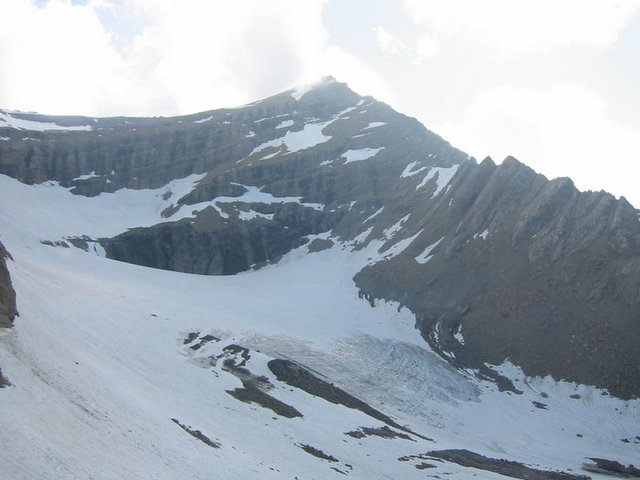
This is all that remains of the glacier below El Tallon (3130 metres) in the Pyrennees. It was gushing meltwater when I examined it close up in the evening in June 2005. Another few hot summers and it'll be gone.


Wednesday, January 11, 2006
Trapped: it's the planet, stupid!
All is not well with our planet as we are regularly reminded by a string of reports, the latest being the Millennium Ecosystem Assessment. And the fault is ours. Though politicians make speeches paying lip service to the environment, business continues as usual. Coal is mined; forests are burned; people still fly off on holidays; the planet warms. So why can’t we free ourselves from this relentless cycle of resource overuse? Are we locked in to an economic system, depending as it does on exploitation, even though we know it’s a system that’s bound to come tumbling down (maybe taking most of us with it)? Are we trapped into pillaging of the planet’s life support systems even though we know it can’t go on?
Even now, many countries behave as if they were not all connected to and dependent on the biosphere, a lesson still not understood − particularly by nationalists. The universal excuse for doing nothing is always ‘the economy’.
So what’s being done? Not much. What are the stumbling blocks: one, ironically, is democracy because it ensures that nothing unpopular can be done; worse is outright denial that there’s a problem at all. Yet there is a way forward, difficult but possible. Otherwise we’re back to the dilemma we all face: the planet’s cry for help isn’t getting through. It seems we really are trapped.
Friday, January 06, 2006
Subscribe to:
Posts (Atom)
