Thursday, March 09, 2006

War on the atmosphere: military aircraft emissions

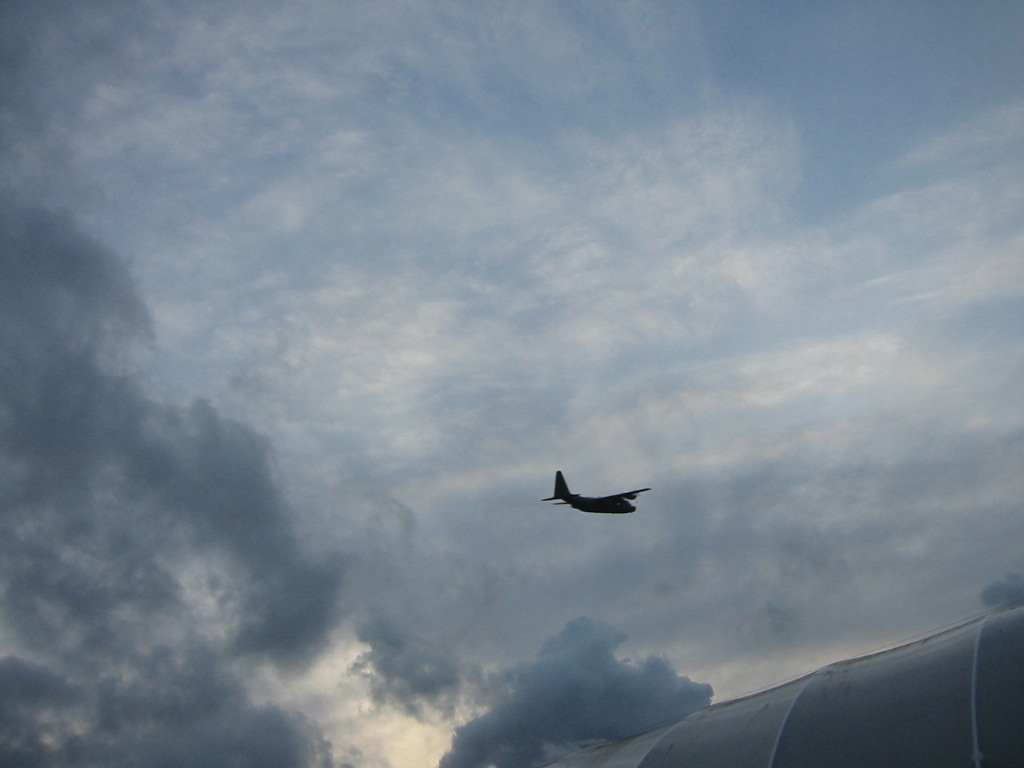
Low-flying aircraft above our polytunnel Insult to injury: George Monbiot's latest piece on aircraft emissions prompts this post; something I've been considering for some time. It is, in turn, prompted by the daily screech and roar of military aircraft over this 'peaceful' country haven in north Wales. Quite apart from any other considerations, this daily air and noise pollution is a continual affront to our attempts to live here as sustainably as possible. With one economical car (65mpg average and 116 grams/kilometre CO2 output), a wood-burner, low-energy lights, insulation and central heating used sparingly, our lifestyle is as low carbon as you can reasonably get in the carbon-fuel-dependent UK. Probably these aircraft burn up what we use in a year in just a couple of hours... but I don't know. Who does?... Or is it secret?

Aircraft emissions and the atmosphere: Okay, here's the issue: we know aircraft emissions are really bad for the environment, especially those at high altitude. Just how much fuel do the airforces of the world squander on training flights (or war games for big boys and their very expensive toys as I'm uncharitably inclined to regard them after the tenth jet in twenty minutes)? What proportion of total aircraft emissions do they represent? I have no idea but I'll bet it's more than you might think. No doubt it's a closely-guarded military secret. And what's it all for? That gross euphemism 'defence' (Orwell warned of this) is bandied about by politicians everywhere. But what's the point of it all (and upgrading nuclear 'deterrents' come to that)? In what way are these scary warplanes and their undoubtedly skilled pilots increasing our security in Britain? Consider little Costa Rica appropriately about the size of Wales: This little country doesn't have an airforce or any military force. The country is still there... and it has land borders with its neighbours making invasion easy, unlike seabound Britain.

Is war more important than climate? The biggest problem facing the planet now is climate change. Most of us, including politicians, would agree with that. So who is about to attack the UK which requires a large active fuel-burning airforce to repel? Terrorists? But everyone knows that terrorists' weapons are suicide bombers and cars packed with explosives. They don't use aircraft - except as flying bombs, one infamous day, in 2001. So why must we put up with this squandering of limited resources on things like military aircraft and the resultant pollution which endangers everyone, not to mention useless nuclear weaponry? Or is there another agenda we ordinary folk don't hear about, like invading Iran - as if the disaster of the US/UK invasion of Iraq wasn't lesson enough? Or maye it's just successive UK governments' desire to have access to the 'top tables' with their American friends, perpetuating the absurd post-colonial notion of 'punching above our weight' and the so-called 'special relationship' which must be nurtured at all costs? That's a lot of questions but how can I get some answers? I have asked my MP to enquire and he is doing so.

Lives are at stake here.

Monday, February 20, 2006

Every little helps: alternative energy sources

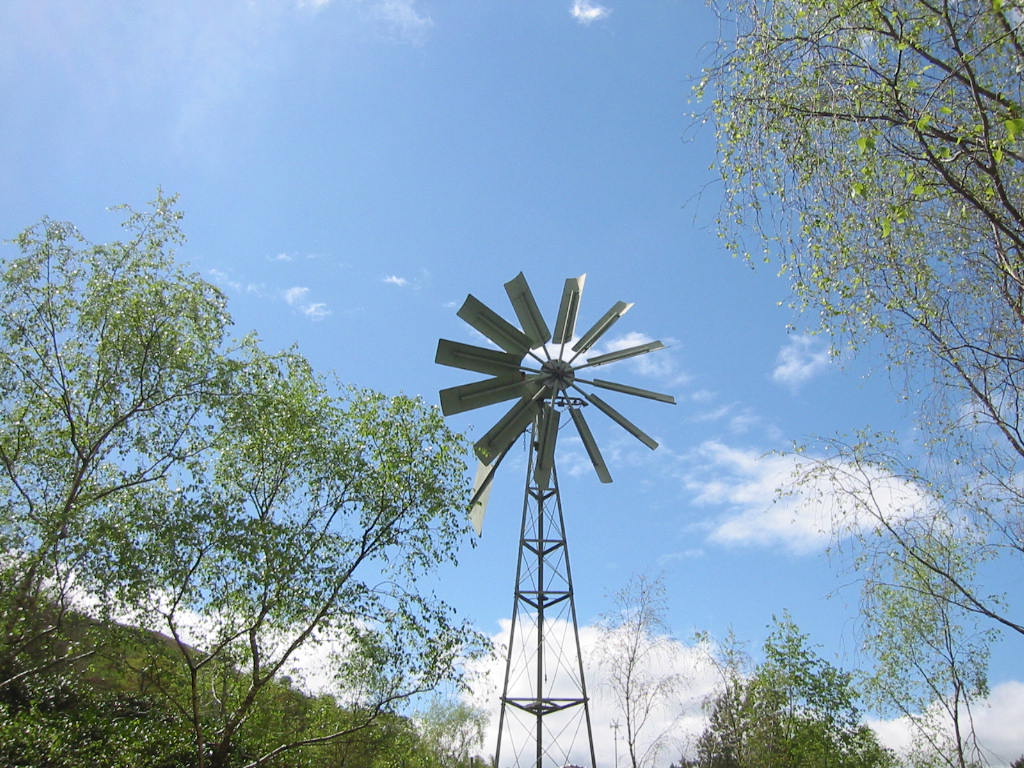
Old-fashioned wind pump
The problem with alternative energy sources is that they're either periodic (like tides or solar) or unreliable (like wind). The one exception is hydropower.

But isn't this the biggest obstacle to the wholesale adoption of renewables in the near future?

Well that was how I thought until my brother-in-law pointed out that every unit of renewable enery produced is a unit of fossil-fuelled energy saved. Blindingly obvious, of course, but I hadn't quite got into thinking that way. I had been commenting that all renewable generators required a battery or back-up system which was expensive and likely to depend on fossil fuels - or nuclear power. None of this alters the basic premise that a unit of energy produced (by, e.g., the turbine on your roof) is a unit which doesn't need fossil fuel to make. I repeat myself, I know, but then this is so fundamental, it needs to be repeated. And the argument about back-up sources really isn't very critical since the fossil-fuelled kit (power stations) already exists. Better weather forecasts mean that extra capacity needs can be anticipated well in advance so that boilers and turbines - not something you can swtich on and off at will - can be started. The aim, after all, is not to cease burning all fossil fuels, but to reduce their use by 60-80% to help stabilise the climate.

What's more, the larger the transmission grid (I know there are losses here), the more it can be used as a 'battery'. Gales in Scotland mean surplus generation for that part of the country which can be 'exported', via the grid, to areas of calm. Indeed, such grids cross national boundaries (like the connection between France and the UK) which enlarges the scope of renewables even further. Perhaps it would be feasible for large scale solar electricity to be produced in hot deserts like the Sahara, at the same time giving those countries a new exportable commodity.

Like I say, every little helps...

Tuesday, January 17, 2006

Advice to a daughter (with kids) in a warming world

"As the temperature starts to rise abnormally because of human activity, feedback mechanisms will turn harmful in their effect, and put the situation beyond our control." James Lovelock, Independent, 16 January 2006.
(http://news.independent.co.uk/environment/article338879.ece)

Alsaskan glacier, taken by my father. Alaska is warming fast!I'd sent my daughter the above link which describes the grim future which is likely for people in a warming world. She, obviously, is most concerned about her own two children's future. This was my response to her worried reply.

Lovelock's gloomy prediction is depresssing, of course, but I was of the generation which grew up with the serious threat of nuclear armageddon. And we all just carried on doing the things ordinary people do, hoping that matters would improve. They did. I think Lovelock's is very much the worst case scenario and he may be wrong about irreversibility having been reached already. We have to assume that we still have time and do our damndest to kick the politicians into some serious action. Obviously, actions begin at home, but we need much more than this. It's all very well me turning the heating off and refusing to fly but it influences hardly anyone. What is needed is carbon rationing right now, internationally. How can we make the politicians do it?
(For details of how carbon rationing might work, try this guide:
http://tiki.oneworld.net/global_warming/DTQ.html)

It's not just apathy: We had a friend and his wife for a meal recently. Nice pair, normal people, quite aware... and they're about to fly off to Australia for a holiday for 5 weeks. Then he's off skiing. He knows the basic issues but somehow, like almost everyone, he must feel that what he does makes no difference and doesn't really believe warming is happening so he might as well enjoy life. How can we tackle this understandable view?

Linked in to all this is the staggering increase in global population. When I was born (1946), there were about 2350 million people. It's now almost 6.5 billion.

As for Amy and Thomas' future, I think low-key thoughtful preparation for a more difficult world would be a sensible option. You're better placed than many to become moderately able to grow your own food and fuel. Could you also influence their school to teach more in the way of self reliance and alternatives to oil-based lifestyles? Please don't despair: there's plenty to live for and we all have to die of something!

Thursday, January 12, 2006

Sad remains

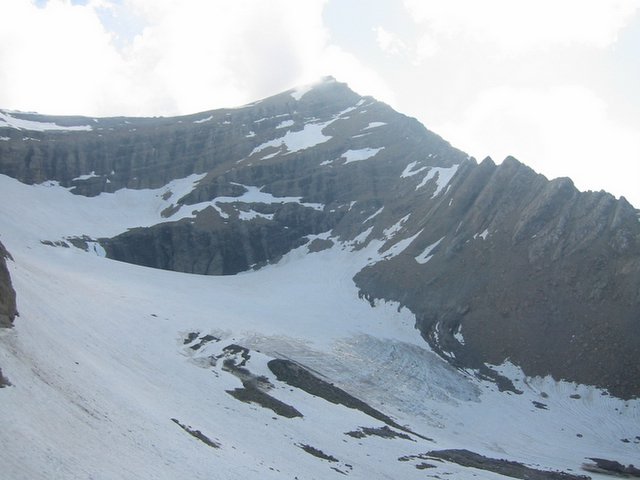
This is all that remains of the glacier below El Tallon (3130 metres) in the Pyrennees. It was gushing meltwater when I examined it close up in the evening in June 2005. Another few hot summers and it'll be gone. Posted by Picasa

Wednesday, January 11, 2006

Trapped: it's the planet, stupid!

All is not well with our planet as we are regularly reminded by a string of reports, the latest being the Millennium Ecosystem Assessment. And the fault is ours. Though politicians make speeches paying lip service to the environment, business continues as usual. Coal is mined; forests are burned; people still fly off on holidays; the planet warms. So why can’t we free ourselves from this relentless cycle of resource overuse? Are we locked in to an economic system, depending as it does on exploitation, even though we know it’s a system that’s bound to come tumbling down (maybe taking most of us with it)? Are we trapped into pillaging of the planet’s life support systems even though we know it can’t go on?

Even now, many countries behave as if they were not all connected to and dependent on the biosphere, a lesson still not understood − particularly by nationalists. The universal excuse for doing nothing is always ‘the economy’.

So what’s being done? Not much. What are the stumbling blocks: one, ironically, is democracy because it ensures that nothing unpopular can be done; worse is outright denial that there’s a problem at all. Yet there is a way forward, difficult but possible. Otherwise we’re back to the dilemma we all face: the planet’s cry for help isn’t getting through. It seems we really are trapped.